
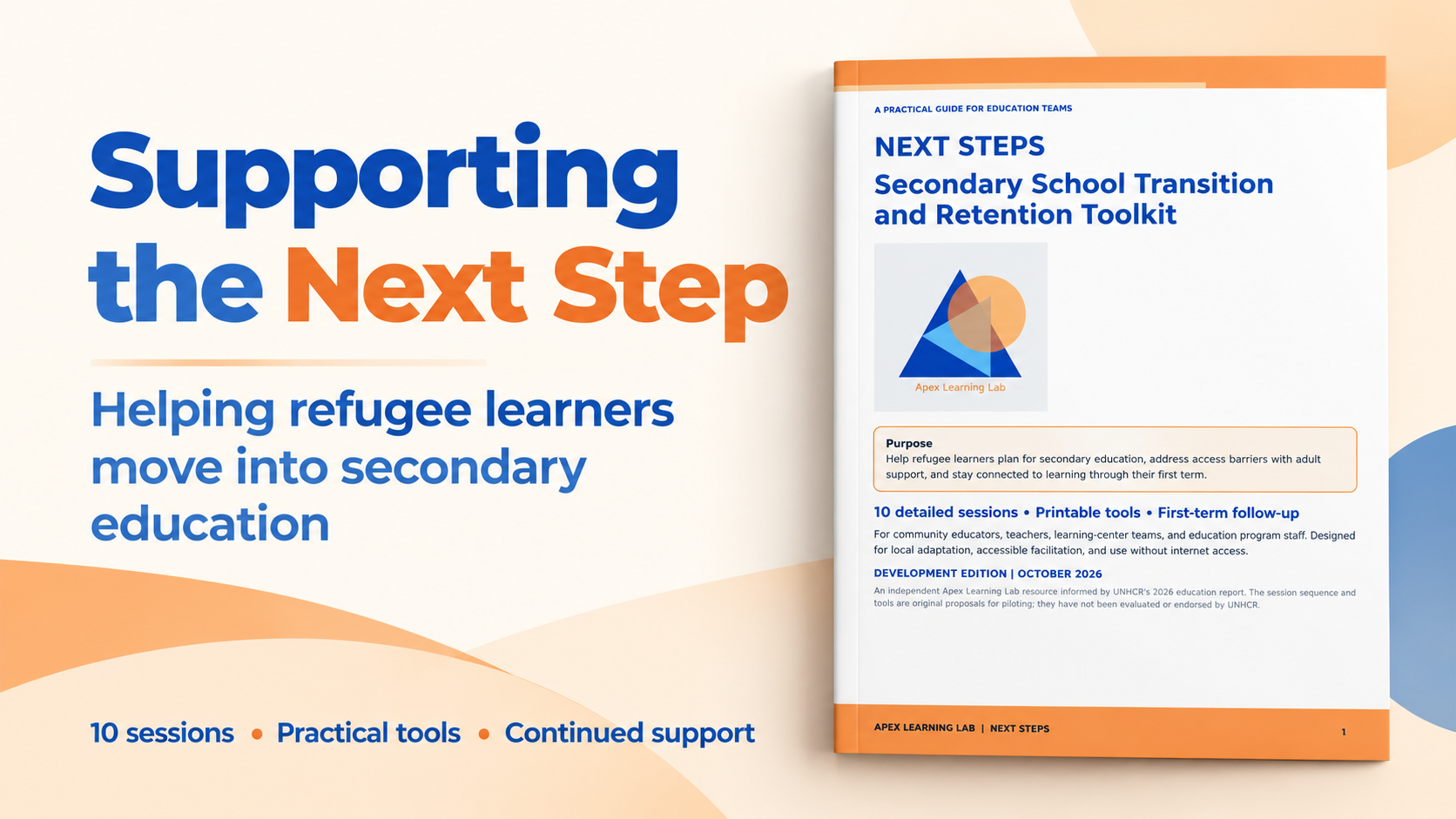
Apex Learning Lab’s Next Steps: Secondary School Transition and Retention Toolkit displayed beside the headline “Supporting the Next Step.” The orange-and-blue graphic highlights 10 sessions, practical tools, and continued support to help refugee learners move into secondary education.
Starting school is an important milestone. Being able to continue learning through each stage of education matters just as much.
UNHCR’s recently released Pathways to the Future: Education, Opportunity and Self-Reliance brings this challenge into focus. The report identifies secondary education as a major bottleneck in the refugee education pathway. Its findings prompted Apex Learning Lab to consider a practical question: How can educators and community programs better support learners before, during, and after this transition?
That question shaped the development of Next Steps: Secondary School Transition and Retention Toolkit.
What the report tells us
UNHCR reports that the global refugee gross enrollment rate reached 65% at the primary level but only 32% at the secondary level in 2025 (UNHCR, 2026, pp. 8–9).
These figures describe participation at different education levels. They do not track the same learners over time or tell us exactly how many primary school graduates failed to enter secondary school. Nevertheless, they highlight a substantial gap in access.
The report identifies several barriers that become particularly significant at the secondary level: limited school places, shortages of qualified teachers, school-related costs, and long travel distances. It also describes documentation barriers in Lebanon and additional pressures affecting adolescent girls, including household responsibilities, safety concerns, early marriage, and pregnancy (UNHCR, 2026, pp. 24–25).
These findings show why supporting transition requires attention to the conditions surrounding a learner’s education. A young person may want to continue school while facing costs, admission requirements, or travel arrangements that remain unresolved.
Turning findings into practical support
For Apex Learning Lab, the report provided a starting point for developing a resource that education teams could adapt to their own settings.
The connection between evidence and practice is straightforward. If costs and distance create barriers, transition planning should include realistic cost and transportation discussions. If admission requirements are unclear, someone needs to verify them with the receiving school. If learners need continued support, the process should extend beyond submitting an application.
The report informed these priorities. The session sequence, activities, worksheets, and planning tools are Apex’s own proposed response, developed for local adaptation and piloting.
A central principle runs throughout the toolkit: learners should have a voice in their plans, while adults and institutions take responsibility for addressing access barriers. A young person should not be expected to overcome a shortage of school places or unaffordable transportation through determination alone.
Introducing the Next Steps toolkit
Next Steps is a 50-page guide for teachers, community educators, learning-center teams, and education program staff supporting refugee learners approaching or entering secondary education.
Its ten sessions help learners explore their strengths and goals, understand secondary school, compare education pathways, prepare for enrollment, and identify practical support needs. Later sessions provide opportunities to practice organizing schoolwork, understanding instructions, asking for help, and building supportive relationships.
Each session includes a clear objective, facilitator guidance, demonstrations, practice activities, and a printable learner worksheet. Worked examples and sample responses help facilitators explain tasks without having to invent the teaching materials themselves.
The guide also includes eight implementation tools covering pathway verification, individual transition planning, enrollment, costs and access barriers, caregiver conversations, school visits, first-term check-ins, and monitoring.
The intention is to connect learner preparation with practical adult follow-through.
Continuing support after enrollment
An application, an admission decision, and a learner’s first day of attendance are different milestones. Continued participation requires further attention.
The toolkit therefore includes suggested check-ins during the first week, around the first month, and at the end of the first term. These conversations help teams ask whether agreed support has materialized, what is making attendance difficult, and what learners need next.
The guide cannot create school places, replace sustained academic instruction, or resolve funding shortages. Its contribution is to help education teams organize the support within their reach—and document the barriers that require wider action.
UNHCR’s report makes the challenge visible. Through Next Steps, Apex Learning Lab aims to help educators and community programs turn that evidence into thoughtful, practical support for the next stage of a learner’s education.
Next Steps is an independent Apex Learning Lab resource. It has not been evaluated or endorsed by UNHCR.
Reference
United Nations High Commissioner for Refugees. (2026). Pathways to the future: Education, opportunity and self-reliance. UNHCR education report 2026.
